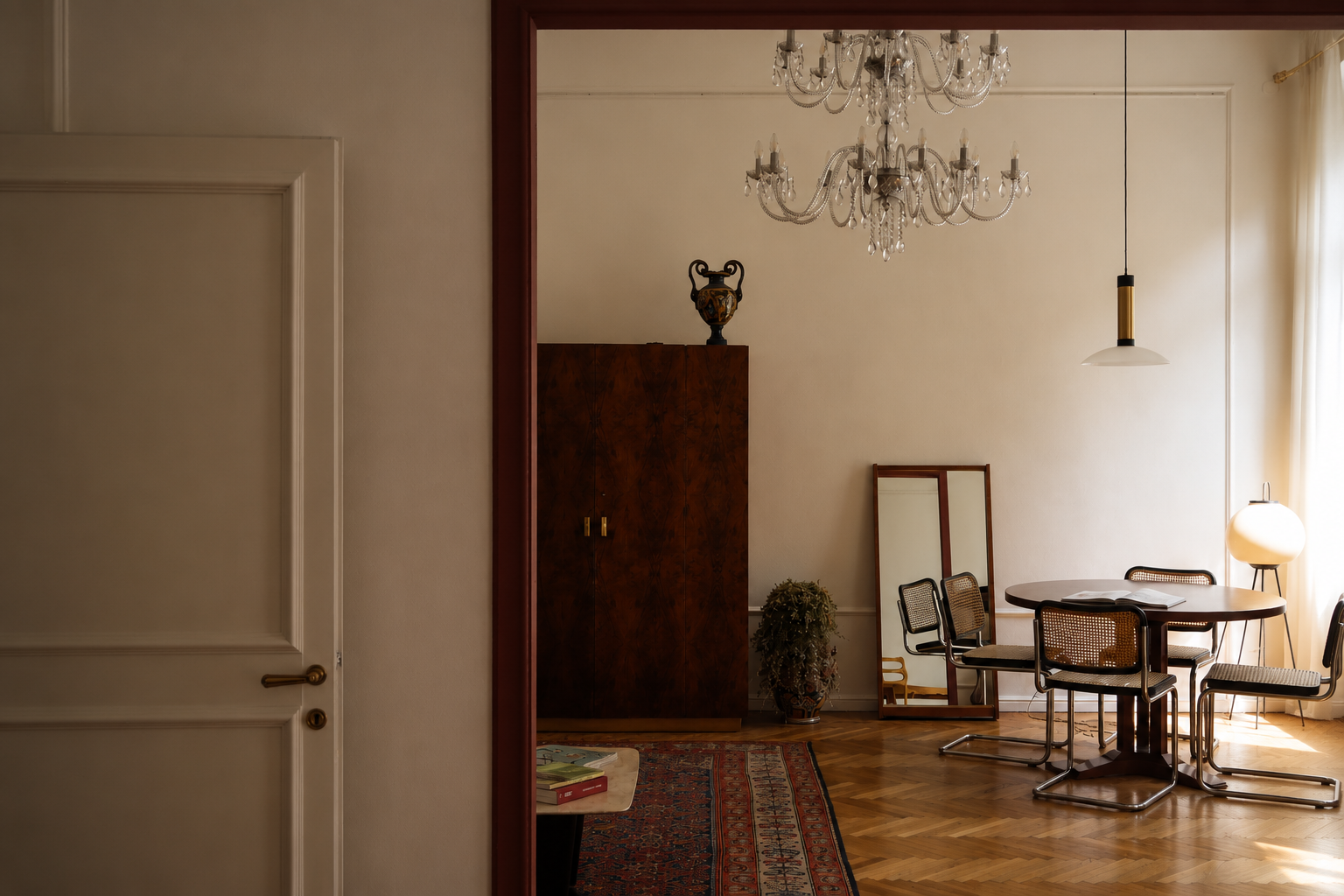

Restoring a piece of designer furniture does not simply mean repairing it, refinishing its surface or returning it to a uniformly new appearance. It means understanding its design, identifying the materials and techniques used in its construction, and distinguishing authentic signs of age from alterations that compromise its stability, function or legibility.
When restoring designer furniture and twentieth-century pieces, every intervention should begin with a question: what makes this object unique, and what must be preserved so that it remains so?
This principle lies at the heart of Visione Antiquaria’s approach. At the workshop in Via Giosuè Carducci 27A, Milan, restoration complements the gallery’s research and selection work, becoming an essential part of the process through which each piece is studied, recovered and returned to a contemporary interior.

Restoring twentieth-century design requires a specific perspective
A twentieth-century piece of furniture may combine solid woods, fine veneers, burr woods, metals, glass, plastics, upholstery and both industrial and handcrafted finishes. The coexistence of these materials makes the restoration of vintage design different from that of antique furniture and requires standardised solutions to be avoided.
An Italian armchair from the 1940s, a rosewood table from the 1950s and a storage cabinet from the 1960s belong to different design cultures. Their construction, the way their surfaces reflect light, the relationship between structure and covering materials and, above all, the original intention of the designer or manufacturer all differ.
Before any work begins, the piece must therefore be considered in its entirety: its proportions, wood species, hardware, joints, finish, upholstery, previous restorations and history of use. The objective is not to apply a predetermined formula, but to identify the treatment most consistent with the specific nature of the object.

Patina, wear and damage: learning to distinguish between them
Not every trace of time is a defect. A gently oxidised surface, a change in the colour of the wood or normal wear may contribute to the depth and authenticity of a piece. By contrast, lifting veneers, unstable joints, wood-boring insect damage, warping, deep abrasions or inappropriate old coatings may require targeted intervention.
Distinguishing between patina and damage is one of the most delicate stages of the process. Indiscriminately removing every imperfection can impoverish a piece just as much as neglecting its structural problems. A successful restoration therefore seeks balance: preserving what bears witness to the object’s history while addressing what compromises its appearance, safety or longevity.
The result should appear natural. The furniture becomes stable, visually coherent and fully functional once again, without losing the character bestowed upon it by time.
From preliminary analysis to a restoration plan
Every intervention carried out in the Visione Antiquaria workshop begins with a preliminary assessment. Whenever possible, the designer, manufacturer, production period and materials are identified. The condition of the structure and surfaces, together with any previous interventions, is then carefully examined.
This stage makes it possible to establish the priorities and limits of the restoration. Depending on the condition of the piece, the work may include:
- gradual cleaning of the surfaces;
- structural consolidation and repair of the joints;
- reattachment of loose or unstable elements;
- repair of veneers, edges and small missing components;
- treatment and cleaning of the hardware;
- chromatic integration of repairs and infills;
- revival or reconstruction of the finish where necessary;
- revision of the upholstery and coverings while respecting the original proportions.
The choice of materials and techniques always depends on the individual piece. Restoration is not a fixed sequence of operations, but a project developed around the object itself.
French polishing with shellac and the depth of wood
Among traditional finishes, French polishing with shellac holds a particularly important place. Applied through a series of gradual, controlled stages, it enhances the depth of the wood, the continuity of its grain and the visual richness of materials such as rosewood, mahogany and walnut.
It is not, however, applied indiscriminately. An appropriate finish must be consistent with the period, material and design language of the furniture. In some cases, preserving and reviving the existing surface is preferable; in others, altered older layers must be reduced or a severely compromised finish reconstructed. The level of sheen must also be carefully calibrated: the objective is not an artificial effect, but a surface capable of restoring light, materiality and proportion.
It is in the quality of the finish that craftsmanship becomes both most apparent and most discreet. When the restoration is successful, the technique does not overpower the object: it allows its quality to be perceived once again.
Restoration and the value of designer furniture
Within the historic design market, the quality of a restoration influences both the perception and value of a piece. An excessively invasive intervention may remove original materials, alter construction details or create a surface that is inconsistent with the period. Equally, furniture that has not been properly consolidated or conserved may deteriorate over time and become difficult to use.
Value does not depend solely on the name of the designer. Authenticity, rarity, provenance, quality of execution, condition and the consistency of previous interventions all matter. Restoring well therefore also means knowing when to stop, documenting the decisions made and preserving the legibility of the object’s material identity.
At Visione Antiquaria, selection and restoration form part of the same process. Knowledge of the market helps identify the features that must be protected, while an understanding of furniture construction makes it possible to intervene without altering its original language.
The Visione Antiquaria restoration workshop in Milan
The workshop in Via Giosuè Carducci 27A was conceived not only as an operational space, but also as a place dedicated to the observation and culture of furniture. Here, pieces are examined, restored and prepared either to enter the gallery’s collection or to return to the homes of clients, collectors, architects and interior designers.
The service covers antique furniture, twentieth-century Italian furnishings, vintage pieces and collectible design. Every project is assessed individually, as the period, materials, condition and intended use determine the work required, as well as its cost and timeframe.
To request an initial assessment, clients may send photographs showing the complete piece, together with close-up images of its surfaces, damaged areas and any labels or manufacturer’s marks. Following this preliminary examination, the furniture can be inspected in person to determine the most appropriate restoration plan.
Request an assessment
For information about the restoration of designer furniture and twentieth-century pieces in Milan, please contact Visione Antiquaria and include several photographs of the piece together with a brief description of its condition.
Visione Antiquaria
Via Giosuè Carducci 27A, Milan
info@visioneantiquaria.com
+39 392 2100199
Visits and consultations by appointment.